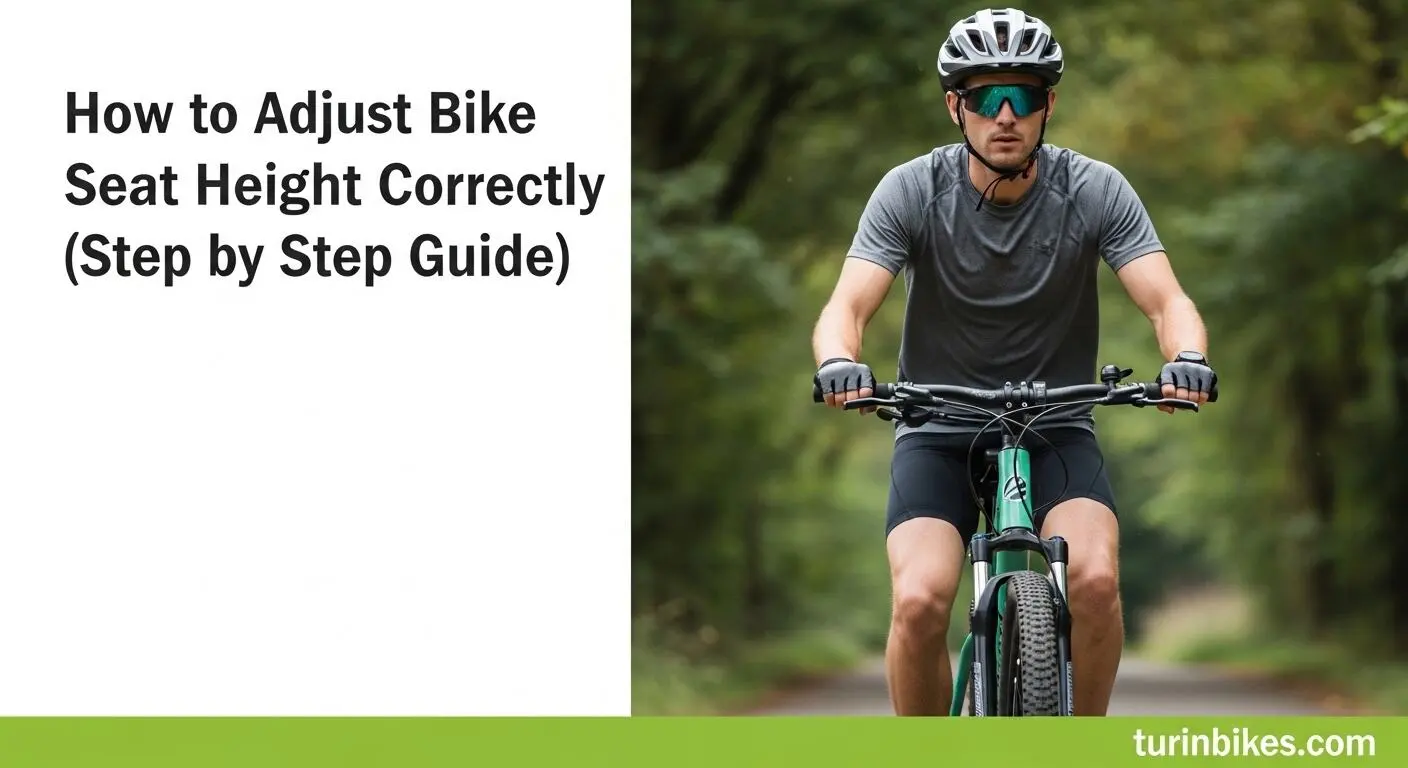
Most cyclists are riding with their saddle in the wrong position. Not dramatically wrong, not obviously wrong, but just enough off that their knees ache after an hour, their legs feel heavy before they should, and every pedal stroke costs slightly more energy than it needs to. The fix is almost always saddle height.
I spent a long time riding with my saddle too low. I thought I was being cautious, keeping my feet close to the ground for confidence at stops. What I was actually doing was forcing my knees into an awkward bent position on every single pedal stroke, thousands of times per ride. The moment I got my saddle height dialed in properly, the difference was immediate and honestly a bit embarrassing to admit that I had not done it sooner.
This guide walks you through exactly how to adjust your bike seat height the right way. We will cover the three main methods cyclists actually use, what to look for while you ride, how to adjust saddle angle, and what the common mistakes feel like so you can catch them early.
| QUICK ANSWER: The correct saddle height puts a slight bend in your knee of roughly 25 to 30 degrees when the pedal is at its lowest point. Your hips should not rock side to side and you should not feel like you are reaching down to the pedal. |
Why Getting Your Saddle Height Right Actually Matters
Before getting into the how, it helps to understand what an incorrectly set saddle actually does to your body. This is not about being fussy or precious about bike fit. It is about the simple fact that cycling is a repetitive motion. A single one hour ride on a road bike at a comfortable cadence involves somewhere around 5,000 pedal strokes per leg. If each of those strokes puts your knee in a slightly wrong position, that adds up fast.
When the saddle is too low, your knee stays in a deeply bent position through most of the pedal stroke. The quadriceps and patellar tendon work harder than they need to. Riders who chronically ride with the saddle too low often develop pain at the front of the knee, just below the kneecap. They also lose a significant amount of power because the leg cannot reach full extension at the bottom of the stroke.
When the saddle is too high, the opposite problem emerges. To reach the pedal at the bottom of the stroke, the hip rocks from side to side. Over time this creates lower back pain, discomfort on the outside of the knee from iliotibial band strain, and sometimes sharp pain at the back of the knee from overextension. Your heel will often drop below level at the bottom of the stroke as the leg tries to reach the pedal.
At the correct saddle height, your leg produces power efficiently through the entire pedal stroke. The crank reaches its lowest position just as your leg approaches near full extension. Your hips stay still. Your foot stays level or with a slight natural drop of the heel. Riding simply feels easier.
| GOOD TO KNOW: A saddle that is only 5mm too low or too high can noticeably affect your comfort and efficiency. You do not need a dramatic misalignment to feel the effects across a longer ride. |
What You Need Before You Start
Adjusting your saddle height does not require a trip to the bike shop or a wall of specialized tools. Most riders can do this at home with things they already own.
- Allen key or hex wrench: The most common size for seatpost clamp bolts is 4mm, 5mm, or 6mm. Some bikes use a quick release lever instead, which needs no tools at all.
- A tape measure: You need this if you are using the inseam formula method, which gives you the most precise starting point.
- A wall or doorway: Something to lean against while you sit on the bike, so you can check position without wobbling around.
- Your regular cycling shoes: This is important. Always do your saddle height adjustment wearing the shoes you actually ride in. The stack height of your shoes and pedals is part of the equation. Checking height in trainers when you ride in stiff cycling shoes will give you the wrong result.
- A friend or a trainer stand (optional but helpful): Having someone watch your pedal stroke from behind makes it much easier to spot hip rocking, which is the clearest sign of a saddle that is set too high.
Method One: The Heel on the Pedal Method
This is the most widely used starting point for adjusting saddle height, and it works remarkably well for most riders. It is quick, requires no measurements, and gives you a sensible baseline within a couple of minutes.
How to do it
Put your bike in a doorway or against a wall so you can sit on it without it rolling forward. Wear your cycling shoes. Sit on the saddle and place your heel on the pedal, then rotate the pedal backward until it reaches the lowest point of the stroke, which is the six o’clock position with the crank pointing straight down in line with the seat tube.
At this point your leg should be completely straight with your knee fully extended but not locked out and straining. This is the correct height.
Now shift your foot forward so the ball of your foot is positioned over the center of the pedal axle, which is where your foot naturally sits when you actually ride. You will now see a slight bend in your knee. That slight bend is exactly what you want when riding.
| THE LOGIC BEHIND IT: When your heel is on the pedal and your leg reaches full extension, moving your foot forward to the ball of your foot shortens the effective leg length slightly. This naturally creates the slight knee bend that allows efficient power transfer without overextension. |
What to watch for
If your heel cannot reach the pedal at the bottom of the stroke, or you have to rock your hip sideways to make contact, the saddle is too high. Lower it by one centimeter at a time and recheck.
If your knee is noticeably bent even with your heel on the pedal at the bottom of the stroke, the saddle is too low. Raise it in small increments, roughly five millimeters at a time, until your leg straightens properly.
Method Two: The Inseam Formula
The formula method is slightly more precise because it accounts for your actual leg length rather than relying purely on feel. It is the approach most bike fitters use as a starting point before making fine adjustments. There are two main versions of this calculation.
How to measure your inseam
Stand barefoot on a hard floor with your back flat against a wall and your feet about shoulder width apart. Take a hardback book and slide it firmly up between your legs as if it were a bicycle saddle, pressing it upward with reasonable pressure. Have someone mark the wall at the top edge of the book, then measure from the floor up to that mark. That measurement is your cycling inseam.
| Formula | Calculation | What it measures |
| LeMond Method | Inseam x 0.883 | Bottom bracket center to top of saddle |
| Hamley Method | Inseam x 1.09 | Pedal axle to top of saddle (crank included) |
Using the LeMond formula
Multiply your inseam length in millimeters by 0.883. For example, if your inseam measures 820mm, the calculation gives you 820 x 0.883 = 724mm. This figure is the distance you need between the center of your bottom bracket and the top of your saddle, measured along the seat tube angle.
| WORKED EXAMPLE: Inseam: 820mm | 820 x 0.883 = 724mm | Set distance from bottom bracket center to saddle top to 724mm along the seatpost. |
Using the Hamley formula
The Hamley formula uses a slightly different measurement. Multiply your inseam by 1.09. Using the same 820mm inseam: 820 x 1.09 = 894mm. This measurement runs from the center of the pedal axle at the bottom of the stroke up to the top of the saddle. The reason the number is larger is that the crank length is included in the measurement.
Both formulas land you in roughly the same physical saddle position. The LeMond formula is slightly easier to measure on the bike since you are measuring to the frame rather than a moving pedal. Use whichever feels more intuitive.
One important caveat: these formulas are starting points, not final answers. They do not account for differences in femur length, foot arch, hip mobility, or pedaling style. After setting your saddle by formula, always go for a short test ride and assess how it feels in motion.
Method Three: The Knee Angle Approach
This is the most precise of the three methods and is standard practice in professional bike fitting. Instead of using a formula based on your inseam, you measure the actual angle of your knee at the bottom of the pedal stroke and adjust the saddle until that angle sits within the target range.
The target knee bend at the six o’clock position is generally accepted to be between 25 and 35 degrees, with most riders landing somewhere around 30 degrees for a good balance of comfort and power.
How to do it without a professional fitting
The simplest approach is to use your smartphone. Set up your bike on a stationary trainer or leaning against a wall, then have someone take a short video of you pedaling from the side. Watch the video back and pause it when the pedal reaches its lowest point. You can use a free angle measuring app to assess your knee flexion, or simply estimate based on what you see.
If the angle looks clearly greater than 35 degrees your saddle is too low. If your leg is almost fully locked out with barely any bend your saddle is too high. Adjust in five millimeter increments and refilm until the angle sits comfortably in the 25 to 35 degree window.
| PRO TIP: Video analysis from the side is genuinely useful even outside a professional bike fit. It takes five minutes and gives you information about your position that you simply cannot feel from on top of the bike. |
How to Actually Move the Saddle
Once you know where your saddle needs to be, the mechanical process of moving it is straightforward. The seatpost slides up and down inside the seat tube of the frame and is held in place by a clamp at the top of the seat tube.
For a standard threaded clamp
Use your Allen key to loosen the bolt on the seatpost clamp. You do not need to remove it completely, just loosen it enough that the seatpost can slide freely. Raise or lower the saddle to your target position and retighten the bolt. If your frame or seatpost has a torque specification marked on it, use a torque wrench to tighten to that value. This matters most with carbon fiber components where overtightening can cause damage.
For a quick release clamp
Open the quick release lever, adjust the saddle height, and close the lever firmly. Give the saddle a few firm pushes downward to confirm it is not slipping. If it moves, open the quick release, turn the adjusting nut a quarter turn clockwise to increase clamping force, and try again.
| SAFETY CHECK: After any saddle height adjustment, always do a firm downward push on the saddle before you ride. A seatpost that slips mid ride is dangerous. If your seatpost keeps slipping, clean both the post and the inside of the seat tube and either apply fresh grease to a metal post or carbon assembly paste to a carbon post. |
Most seatposts have a minimum insertion mark stamped on them, usually showing as a line with MIN INSERT written next to it. The seatpost must never be raised above this line. If you need your saddle higher than the minimum insertion mark allows, the bike may simply be too small for you.
Adjusting Saddle Angle
Saddle height gets all the attention, but saddle angle is worth a moment too. A saddle tilted too far upward puts pressure on soft tissue at the front of the pelvis. A saddle tilted too far downward causes you to slide forward on every pedal stroke, shifting weight onto your hands and wrists.
For most riders, a level saddle is the best starting point. You can check this quickly with any spirit level app on your phone placed flat on the saddle surface. Some riders find a very slight downward tilt of one or two degrees comfortable on road bikes where they are in a more aggressive position, but start level and deviate only if you have a specific reason.
How to adjust the saddle angle
The saddle is attached to the seatpost via a clamp mechanism that is sometimes called the saddle clamp or saddle rail clamp. On most modern bikes you loosen one or two bolts on this clamp, rotate the saddle to the desired angle, and retighten. Some designs use two separate bolts, one at the nose and one at the back of the clamp. On these designs, tightening the front bolt tips the nose down and tightening the rear bolt tips the nose up.
Signs Your Saddle Is Still in the Wrong Position
After making adjustments, the feedback you get while riding tells you more than any measurement. Here is what to feel for on your next ride.
Your saddle is probably too high if
- Your hips rock side to side as you pedal, particularly noticeable at higher cadence
- You feel a pulling sensation at the back of your knee or in your hamstrings at the bottom of the stroke
- Your heel drops well below horizontal at the bottom of the pedal stroke
- You feel lower back discomfort that builds over the course of a ride
Your saddle is probably too low if
- You feel fatigue and burning in your quadriceps earlier than expected
- There is pressure or aching at the front of your knee, just below or around the kneecap
- Your knees track outward or inward during the pedal stroke rather than moving cleanly up and down
- You feel cramped on the bike, as though there is not enough room for your legs to extend properly
Your saddle height is in a good place when
- Your hips stay still and level throughout the pedal stroke
- Your legs feel like they are doing work through the full circle rather than just pushing down
- There is a comfortable, relaxed bend in your knee at the top and a near but not full extension at the bottom
- Longer rides feel manageable rather than progressively more painful in the knees or lower back
| AFTER MAKING CHANGES: If you have significantly raised your saddle after a long period of riding too low, give your body time to adapt. Your muscles and connective tissue have been working in a specific pattern. A large sudden change can cause temporary soreness even when the new position is better. Make gradual changes and build up ride time in the new position. |
Quick Reference: Common Saddle Adjustments by Symptom
| Symptom you feel while riding | Likely adjustment needed |
| Knee pain at the front below the kneecap | Raise the saddle slightly |
| Knee pain at the back of the knee | Lower the saddle slightly |
| Hips rocking side to side | Lower the saddle, currently too high |
| Feeling cramped, quads burning early | Raise the saddle, currently too low |
| Lower back ache building over rides | Often saddle too high, lower by 3 to 5mm |
| Heel dropping at bottom of stroke | Lower the saddle |
| Foot reaching for pedal at bottom | Lower the saddle |
| Numb or sore in the perineal area | Check saddle angle, tilt nose down slightly |
| Sliding forward on the saddle constantly | Check saddle angle, level or tilt nose up slightly |
When to Visit a Bike Shop for a Proper Fit
The methods in this guide will get the vast majority of riders to a comfortable and efficient saddle position. They work because human anatomy follows predictable enough patterns that a formula or heel method gives you something close to optimal. But there are situations where it is worth investing in a professional bike fit.
If you ride more than three or four times per week, are training for an event, or have persistent discomfort that does not resolve after careful adjustments, a professional fitting is genuinely worth the cost. A qualified bike fitter uses video analysis, body measurements, and sometimes pressure mapping to optimize not just saddle height but saddle fore and aft position, handlebar height, cleat position, and overall riding posture simultaneously.
If you have had a significant injury to your knee, hip, or lower back, or if you have a noticeable difference in leg length between your left and right side, a professional fitting is especially useful. These are situations where standard formulas may need meaningful adjustment from the baseline they provide.
Many bike shops offer fitting sessions for a reasonable fee, and the investment often pays for itself in reduced wear on your knees and a more enjoyable time on the bike.
Final Thoughts
Saddle height is one of those adjustments that cyclists put off because it feels like something you need special knowledge or a professional to sort out. You do not. The heel method takes five minutes and gets most people to within a few millimeters of where they need to be. The formula methods take a bit longer but give you a number you can trust.
The bigger issue is that riders often accept discomfort as a normal part of cycling when the actual cause is a saddle that is just a little too high or too low. The adjustment is free, takes no special tools for most bikes, and the difference it makes to how a ride feels is real.
Get the saddle height right, give yourself a ride or two to feel the difference, and then turn your attention to the other things that affect how your bike fits you. The correct saddle height is the foundation of everything else.
Frequently Asked Questions
How high should a bike seat be for a beginner?
Start with the heel method described above. Sit on the saddle, place your heel on the pedal at the six o’clock position, and check that your leg is fully straight. This gives you a safe and sensible starting height. Then shift to riding with the ball of your foot over the pedal and enjoy the slight knee bend that results. Beginners sometimes set their saddle deliberately low for confidence, but this leads to knee strain over time.
How do you know if your bike seat is too high?
The most obvious sign is hip rocking. If your hips tip side to side as you pedal, particularly when you are pushing harder or spinning faster, your saddle is too high. You might also notice discomfort at the back of the knee, a tendency for your heel to drop at the bottom of the stroke, or lower back tightness that builds during rides.
Does saddle height matter on a casual bike or city bike?
Yes, and it is often worse on casual bikes because people assume fit only matters for serious cycling. A saddle set too low puts strain on your knees regardless of whether you are commuting two miles or racing fifty. The heel method works for any type of bicycle including city bikes, hybrids, and folding bikes.
How often should you check your saddle height?
Once you find a position that works well, you do not need to adjust it constantly. It is worth checking the height has not slipped after any long or rough ride, particularly if you have a quick release seatpost. A quick downward push on the saddle takes two seconds and confirms it has not moved. Otherwise, revisit your setup if you change shoes, change pedals, get a new saddle, or if discomfort returns after a period of comfortable riding.
Can I adjust the saddle height on a bike with a dropper post?
A dropper seatpost lets you lower the saddle quickly on descents and raise it for climbing using a remote lever. The maximum extended height of your dropper post should be set to your correct riding height using the same methods described in this guide. Adjust the maximum height at the post itself, usually via a set screw or internal cable, so that when fully extended the saddle sits at your ideal position.

Sachin Kadwal is the founder of TurinBikes, with 5.5+ years in SEO and digital research. He rides regularly and creates honest, data-backed bike guides based on verified reviews and real-world testing.”