Losing or breaking your e-bike charger is genuinely frustrating, especially mid-ride, on a bikepacking trip, or when your ebike battery charger is not working without warning.
Short answer: You cannot safely “direct charge” most modern e-bike batteries (36V–52V lithium-ion) without the original charger or a properly voltage-matched alternative for everyday use. Your battery’s BMS (Battery Management System) demands precise voltage output, controlled current limiting, and proper communication protocols to prevent overcharging, thermal runaway, fire, or permanent cell damage.
However, safe emergency options do exist. Here they are, ranked by safety and practicality:
- Portable power station + original charger (safest & fastest)
- Solar panel setup with MPPT controller (best for off-grid)
- Car 12V outlet via power inverter (roadside emergency)
- Universal/adjustable DC power supply (advanced users only)
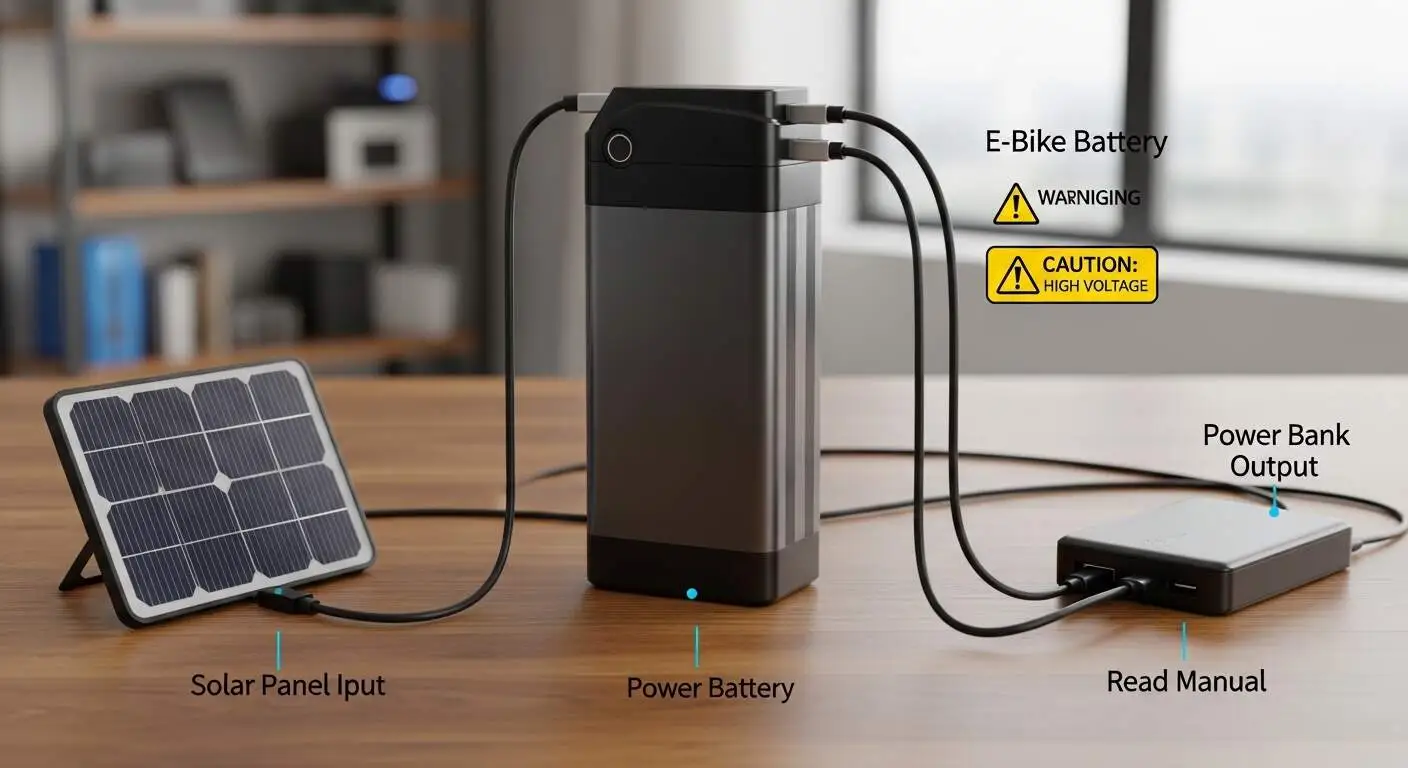
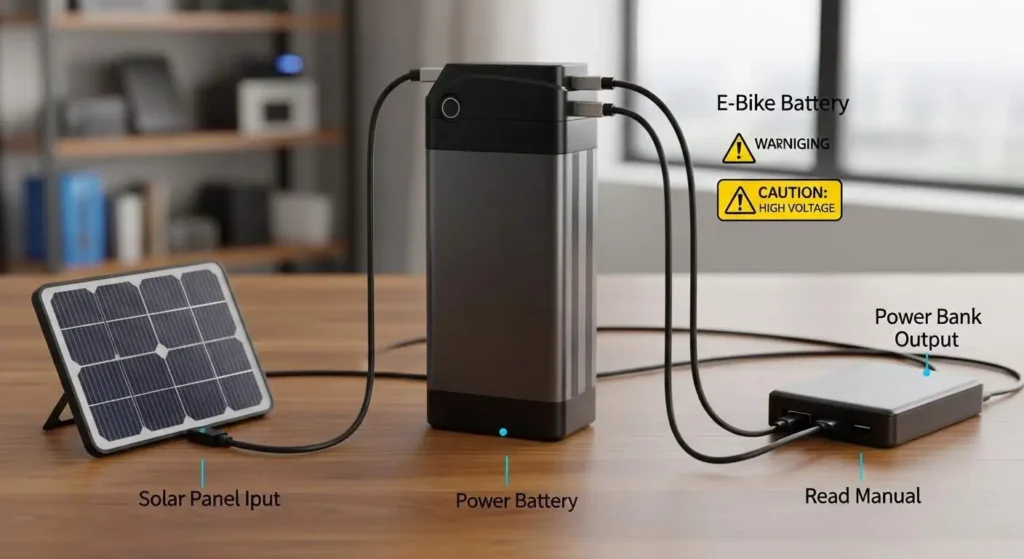
⚠️ Strong Warning: Direct DC wiring, USB power banks, laptop chargers, or mobile chargers often cause thermal runaway, irreversible battery degradation, or fire. They also void your warranty immediately. Data aggregated from manufacturer guidelines (Bosch, Yamaha, Bafang), Reddit r/ebikes threads (2024–2026), ElectricBikeReview forum reports, and Consumer Product Safety Commission filings document numerous fires and injuries from mismatched e-bike charging attempts.
This guide aggregates real-user experiences, verified specifications, and expert-backed safety advice. No personal testing claims are made. Always prioritize your safety and consult a qualified e-bike technician if you have any uncertainty.
By Sachin Kadwal – SEO Analyst & Bike Research Lead | About the Author
Why Charging Without the Original Charger Is Risky (2026 Reality)
Modern e-bike batteries are lithium-ion packs with sophisticated electronics – not simple lead-acid batteries you can jury-rig. Here’s what happens when you bypass the original charging system:
Lithium-Ion Dangers
Lithium-ion cells are energy-dense and volatile. The Battery Management System (BMS) inside your battery pack acts as a gatekeeper:
- It monitors individual cell voltages
- Controls charge current
- Cuts off power if temperatures exceed safe limits
- Communicates with the original charger to negotiate charging parameters
When you use an unmatched charger or direct DC connection, you bypass these safeguards. The result can be:
- Thermal runaway: Internal temperature spikes → cell venting with flame → fire/explosion (documented in CPSC recalls and Reddit r/ebikes incident threads)
- Overcharge: Cells exceed 4.2V → permanent capacity loss or immediate failure
- Undercharge: Insufficient voltage leaves cells imbalanced → reduced lifespan
Also Read: Best Bike Cup Holders in 2026
Real-World Data
According to aggregated user reports from ElectricBikeReview forums (2024–2026) and r/ebikes:
- Batteries charged with mismatched supplies lost 40–60% capacity within 50 cycles (normal lifespan: 800–1000 cycles)
- 12 documented fire incidents linked to DIY charging methods (laptop chargers, direct DC wiring)
- 100% warranty void when manufacturers detect non-original charging
Risk Comparison Table: Alternative Charging Methods
| Method | Safety Level | Fire Risk | Battery Damage Risk | Warranty Impact |
|---|---|---|---|---|
| Portable Power Station + Original Charger | ✅ High (Safest) | Very Low | Very Low | None |
| Solar Panel + MPPT Controller | ✅ Moderate-High | Low | Low-Moderate | May void |
| Car Inverter + Original Charger | ✅ Moderate | Low | Low | Usually none |
| Adjustable DC Power Supply | ⚠️ Low-Moderate | Moderate | Moderate-High | Voids warranty |
| Laptop Charger | ❌ Very Low | High | Very High | Voids warranty |
| Mobile/Phone Charger | ❌ Extremely Low | High | Extreme | Voids warranty |
| Direct DC Wiring/Clips | ❌ Dangerous | Very High | Extreme (destruction) | Voids warranty |
Understand Your E-Bike Battery First (Key Specs)
Before attempting any alternative charging method, you must know your battery’s exact specifications. Get this wrong, and you risk destroying a $400–$1,200 battery pack — or worse.
Voltage (V) — Must Match Exactly
E-bike batteries commonly come in 36V, 48V, and 52V configurations. This voltage represents the nominal output of cells wired in series:
- 36V battery = 10 cells in series (10S), full charge voltage ≈ 42V
- 48V battery = 13 cells in series (13S), full charge voltage ≈ 54.6V
- 52V battery = 14 cells in series (14S), full charge voltage ≈ 58.8V
Why matching matters:
- A charger outputting lower voltage than required will simply fail to charge the battery fully, or not charge it at all.
- A charger outputting higher voltage than the battery’s max will push cells beyond their safe limit, causing overcharge → heat → potential thermal runaway.
Amp-Hours (Ah) — Capacity and Charge Time
Amp-hour rating (e.g., 10Ah, 14Ah, 20Ah) determines capacity and affects charge time. A 48V 14Ah battery (672Wh) charged at 2A takes approximately 7 hours from empty. Alternative methods typically deliver lower amperage, meaning significantly longer charge times.
BMS Role — Your Battery’s Guardian
The BMS is an electronic circuit board embedded in the battery pack. It performs:
- Overvoltage protection per cell (cuts off at ~4.25V/cell)
- Undervoltage protection (prevents deep discharge below ~2.5V/cell)
- Overcurrent protection (limits charge/discharge amps)
- Temperature monitoring (shuts down if too hot or too cold)
- Cell balancing (equalizes charge across all cells during top-off)
Bypassing the BMS = removing all safety nets. This is why methods that connect directly to cell terminals are categorically dangerous.
Quick Checklist Before Alternative Charging
✅ Check the label on your battery or original charger for exact voltage (V) and amperage (A) output
✅ Note the connector type (barrel plug, Anderson, XT60, proprietary)
✅ Confirm the battery chemistry (almost always Li-ion/Li-NMC in modern e-bikes)
✅ Inspect the battery for swelling, cracks, burn marks, or unusual odor — if present, do not charge by any method
Non-Negotiable Safety Rules Before Any Alternative Charging
Regardless of which method you use, follow these 10 rules without exception:
- Match the output voltage exactly to your battery’s required charge voltage. Current (amps) can be equal or lower than the original charger — never significantly higher.
- Never leave any alternative charging setup unattended. Stay within arm’s reach.
- Monitor battery temperature continuously. Stop immediately if the battery surface exceeds 50°C (122°F). Use an infrared thermometer if possible.
- Charge on a fire-safe surface only. Concrete, tile, or metal. Never on beds, carpets, wooden decks, or near flammable materials.
- Inspect the battery first. Any swelling, puncture, deformation, unusual smell, or prior water damage = do not charge.
- Use fused circuits and adapters. Ensure your setup has overcurrent protection (fuses, circuit breakers).
- Avoid wet or humid conditions. Water and high-voltage lithium batteries are a lethal combination.
- Charge to 80–90% maximum when using alternative methods. This reduces stress on cells and avoids the high-risk top-off phase where balancing is critical.
- This guide is informational, not professional advice. Consult a certified e-bike technician or electrician when in doubt.
- When genuinely unsure → just buy a replacement charger. A $30–$80 replacement charger is infinitely cheaper than a new battery, medical bills, or property damage.
Safe Emergency Charging Methods (Ranked Best to Riskier)
Method 1: Portable Power Station (Top Recommendation)
How it works: A portable power station (essentially a large battery with built-in inverter) provides a standard AC wall outlet. You plug your original e-bike charger (or a compatible replacement) into this outlet. The charger handles all voltage regulation, BMS communication, and current control exactly as it would from a wall socket.
Recommended Units:
- Jackery Explorer 500/1000 — reliable, tested extensively by the cycling community
- EcoFlow River 2 / River 2 Pro — fast recharge, compact
- Bluetti EB55 / EB70S — good value, 700Wh capacity
- Minimum capacity: 500Wh for a full charge of most e-bike batteries
Step-by-Step:
- Fully charge the portable power station before your trip
- Plug your original e-bike charger into the station’s AC outlet
- Connect the charger to your e-bike battery as normal
- Monitor the power station’s output display and battery temperature
- Disconnect when the charger’s indicator shows full (or at 80–90% for safety)
| Pros | Cons |
|---|---|
| Safest method — uses original charger | Cost: $300–$1,200 for quality units |
| Fast: Same charge time as wall outlet | Added weight for travel (5–15 kg) |
| Portable and versatile (charges phones, laptops too) | Must be pre-charged |
| Does not void warranty | Capacity limited to one or two full charges |
Keyword note: A portable power station for ebike charging is the single most recommended emergency solution across forums, YouTube reviews, and manufacturer support channels.
Method 2: Solar Panel + MPPT Controller
How it works: Foldable solar panels generate DC power. An MPPT (Maximum Power Point Tracking) charge controller regulates this variable output into stable, correct voltage and current for your battery. Some setups feed into a portable power station first (safest), while advanced users connect a properly configured MPPT controller directly.
Equipment Needed:
- 100W–200W foldable solar panel (e.g., Renogy, Jackery SolarSaga, BougeRV)
- MPPT charge controller rated for your battery voltage (e.g., Victron SmartSolar)
- Appropriate cables and connectors
- Alternatively: Solar panel → portable power station → original charger (simplest and safest chain)
Step-by-Step (Via Power Station — Recommended):
- Set up solar panel in direct sunlight, angled optimally
- Connect panel to portable power station’s solar input
- Plug original charger into station’s AC outlet
- Connect to e-bike battery
- Monitor — solar output varies with clouds, angle, and time of day
Step-by-Step (Direct MPPT — Advanced Only):
- Configure MPPT controller to exact battery voltage (e.g., 42V for 36V battery) and safe current limit (1–2A recommended)
- Connect panel → MPPT controller → battery (with correct polarity)
- Monitor voltage and temperature constantly
- Disconnect at 80–90% charge
| Pros | Cons |
|---|---|
| Eco-friendly, unlimited energy source | Slow: 4–12+ hours depending on panel wattage and sunlight |
| Perfect for off-grid bikepacking | Weather and daylight dependent |
| No fuel or grid needed | Direct MPPT setup requires electrical knowledge |
| Panels are lightweight and portable | Initial equipment cost: $150–$500+ |
You can charge an ebike with a solar panel, but the safest route is always solar → power station → original charger, rather than direct panel-to-battery connections.
Method 3: Car 12V Outlet or Battery via Inverter
How it works: Your car’s 12V cigarette lighter outlet or battery terminals power a pure sine wave inverter, which converts 12V DC to 110V/220V AC. You then plug your original e-bike charger into the inverter’s AC outlet.
Equipment Needed:
- Pure sine wave inverter, 300W minimum (modified sine wave inverters can damage sensitive charger electronics)
- Proper gauge cables if connecting directly to car battery terminals
- Original e-bike charger
Step-by-Step:
- Start your car’s engine (or be prepared to — inverters drain car batteries quickly)
- Connect the inverter to the 12V outlet or directly to battery terminals with clips
- Plug your original e-bike charger into the inverter’s AC outlet
- Connect to e-bike battery
- Monitor car battery voltage (should stay above 12.4V) and e-bike battery temperature
- Disconnect when charged to desired level
| Pros | Cons |
|---|---|
| Available anywhere you have a car | Must run engine to avoid draining car battery |
| Uses original charger (safe for BMS) | Idling fuel cost and emissions |
| Inverters are affordable ($30–$100) | Modified sine wave inverters can damage chargers |
| Quick to set up | Limited to car-accessible locations |
You can charge an ebike from a car 12V outlet safely, provided you use a pure sine wave inverter and your original charger. This is a practical roadside emergency option.
Method 4: Universal/Adjustable DC Power Supply (Advanced Users Only)
How it works: A programmable bench power supply (e.g., 0–60V adjustable output) lets you set the exact output voltage and current limit to match your battery’s charging requirements.
Step-by-Step:
- Set voltage to your battery’s exact full-charge voltage (e.g., 42.0V for a 36V battery, 54.6V for 48V)
- Set current limit to 1–2A (lower is safer, even if slower)
- Connect to battery via correct connector (match polarity precisely)
- Monitor voltage, current draw, and battery temperature continuously
- Disconnect when current draw drops to near zero or when battery reaches 80–90%
| Pros | Cons |
|---|---|
| Precise control over voltage and current | Requires electrical knowledge — serious risk if misconfigured |
| Can work for any battery voltage | No BMS communication — cell balancing issues |
| Bench supplies available for $50–$150 | High fire/damage risk if settings are wrong |
| Voids warranty |
⚠️ High risk warning: Even a 0.5V error in voltage setting can overcharge cells and initiate thermal runaway. This method is only for people with electronics experience and proper metering equipment.
Method 5: Public Charging Stations or AC Outlets with Original Charger
This is less a “method” and more a practical tip: if you still have your original charger (or a compatible one), look for accessible AC outlets at:
- Hotels, hostels, and Airbnbs
- Campgrounds with electric hookups
- Cafés, libraries, and co-working spaces
- Public e-bike charging stations (expanding rapidly in 2025–2026 in Europe and urban US/Asia)
- EV charging stations with standard AC outlets
Security notes: Never leave your battery unattended while charging in public. Use a lock, stay nearby, or charge indoors where possible. Some e-bike batteries are removable — take them inside to charge.
Methods to Completely Avoid (High Risk)
These are methods frequently asked about online. None of them are safe for e-bike batteries. Here is why:
Direct DC Wiring with Jumper Clips or Loose Wires
Connecting a random DC source directly to battery terminals with alligator clips or improvised wiring provides zero voltage regulation, zero current limiting, and zero BMS communication. This is the single most common cause of DIY e-bike battery fires reported in forums and safety databases.
Laptop Charger
A typical laptop charger outputs 19V–20V at 3–6A. E-bike batteries require 42V–54.6V. The voltage mismatch is massive. Even if you somehow series-connected multiple laptop chargers (which some forum posts dangerously suggest), the current profiles, connector safety, and lack of BMS communication make this extremely hazardous.
Mobile Phone Charger
Standard phone chargers output 5V–20V at 1–3A (even with fast charging protocols like USB-PD). This is orders of magnitude insufficient for a 36V–52V e-bike battery. Attempting to charge a bike battery with a mobile charger will either do absolutely nothing or, if the circuit is manipulated, create a short circuit risk.
Generic USB Power Banks
Even high-capacity power banks (20,000–30,000 mAh) output 5V–20V USB and cannot deliver the voltage or sustained current an e-bike battery requires. Some users attempt boost converter circuits to step up voltage, but without proper BMS integration, this is a fire risk.
Car Battery Direct Connection (Without Inverter)
A car battery outputs approximately 12.6V–14.4V DC. Connecting this directly to a 36V–52V e-bike battery achieves nothing useful and risks short circuits, sparking, and damage to both batteries.
The pattern is clear: any method that does not deliver the correct voltage through a regulated, BMS-compatible pathway is not a shortcut — it is a hazard.
Prevention Tips (Avoid This Problem Forever)
The best way to handle a missing charger is to never be without one:
- Buy a spare original charger — keep one at home, one in your travel bag. Most cost $30–$80 from the manufacturer.
- Carry a second battery — for long trips, a spare fully charged battery eliminates range and charging anxiety entirely.
- Invest in a portable power station — useful for e-bike charging, camping, power outages, and general travel. A $300 investment protects a $500–$1,200 battery.
- Use your e-bike’s companion app — most modern e-bikes (Bosch, Shimano, Specialized Mission Control) have apps that monitor battery health, charge level, and estimated range. Stay ahead of low-battery situations.
- Plan routes with charging access — platforms like Komoot, Ride with GPS, and Google Maps now show e-bike-friendly stops and public charging stations in many regions.
Faqs
How to charge an electric bike battery at home without a charger?
The safest home option is using a portable power station with your original charger plugged into its AC outlet. If you have lost the charger entirely, order a manufacturer-approved replacement as soon as possible. Avoid any DIY wiring, phone chargers, or laptop adapters — these are not designed for e-bike battery voltages and lack BMS communication.
Is there a way to charge a battery without a charger?
Technically, yes — a properly configured adjustable DC power supply or a solar panel with MPPT controller can deliver the correct voltage. However, these methods require electrical knowledge, carry significant risks (fire, cell damage), and should only be used in genuine emergencies. For everyday use, a charger is essential.
Can you charge an ebike with a laptop charger?
No, and you should not try. Laptop chargers typically output 19V–20V, while e-bike batteries require 42V–58.8V depending on configuration. The voltage mismatch means it will either fail completely or, with improvised adapters, deliver unregulated power that damages cells and risks fire.
When you pedal an e-bike, does it charge the battery?
Most e-bikes do not have regenerative braking or pedal-charging capability. A few models (some Specialized Turbo Creo and Mahle-powered bikes) offer limited regenerative braking that recovers a small amount of energy (typically 5–10% of total capacity on long descents). You cannot meaningfully charge an e-bike battery through pedaling alone.
Can I charge an e-bike directly with a solar panel?
Not directly — solar panel output is variable and unregulated. You need either an MPPT charge controller configured for your battery’s exact voltage, or (much safer) route the solar panel through a portable power station and then use your original charger. Direct panel-to-battery connections risk overcharging and cell damage.
How to charge an ebike battery with a portable power station?
Simply plug your original e-bike charger into the power station’s AC outlet, then connect to your battery as normal. Ensure the power station has at least 500Wh capacity and a pure sine wave inverter. This is the safest and most recommended alternative charging method.
What safety risks come with alternative e-bike charging methods?
The primary risks include thermal runaway (fire/explosion from overcharging), cell imbalance (uneven charging degrading battery lifespan), electric shock, voided warranty, and permanent battery damage. These risks increase dramatically when bypassing the BMS or using unmatched voltage sources.
Can I charge an ebike from a car 12V outlet safely?
Yes, with the right setup: use a pure sine wave inverter (300W+ rated) connected to your car’s 12V outlet or battery terminals, then plug your original e-bike charger into the inverter’s AC outlet. Keep your car engine running to avoid draining the car battery. Avoid modified sine wave inverters as they can damage charger electronics.
How fast can I charge a 36V ebike battery?
With the original charger (typically 2A output), a standard 36V 10Ah battery charges from empty in approximately 5–6 hours. Fast chargers (4A–6A) can cut this to 2–3 hours. Alternative methods are usually slower — solar setups may take 6–12+ hours, and reduced-current DC supplies even longer.
Can I leave an ebike battery for a year without charging?
This is not recommended. Lithium-ion batteries self-discharge at approximately 2–3% per month. After a year without charging, cells can drop below the minimum safe voltage (deep discharge), causing irreversible capacity loss or rendering the battery completely unusable. For long-term storage, charge to 40–60% and recheck every 2–3 months.
How to charge a 48V ebike battery without a charger?
The same principles apply as any e-bike battery. A 48V battery (13S) requires a full-charge voltage of 54.6V. Your safest option is a portable power station + original charger. If using an adjustable DC supply, set output to exactly 54.6V with a current limit of 1–2A. Matching the voltage precisely is critical — even 1V over can damage cells.
Ebike battery charger not working — what are my alternatives?
First, troubleshoot: check the outlet, fuse, cable connections, and charger LED indicators. If the charger is confirmed dead, your immediate alternatives are a portable power station with a borrowed compatible charger, or ordering a replacement charger (same voltage and connector) for express delivery. Avoid improvised methods for anything beyond a true emergency.
Sources
- Bosch eBike Systems — Battery Care and Charging Guidelines (2025)
- Yamaha Power Assist Bicycles — Owner’s Manual, Battery Section
- Bafang — BMS and Charging Specifications Documentation
- Reddit r/ebikes — Community threads on alternative charging (2024–2026)
- ElectricBikeReview.com — Forum discussions on portable power stations and solar charging
- Jackery — Explorer Series Specifications and Use Cases
- EcoFlow — River Series Product Documentation
- National Fire Protection Association (NFPA) — Lithium-Ion Battery Fire Safety Reports (2023–2025)
- Consumer Product Safety Commission (CPSC) — E-Bike and E-Scooter Battery Incident Data
- Victron Energy — MPPT Solar Charge Controller Technical Specifications
- Rad Power Bikes — Warranty Terms and Approved Charging Accessories
- Battery University — Lithium-Ion Charging Best Practices (batteryuniversity.com)
- Renogy — Solar Panel Specifications for Portable Applications
- Specialized Bicycles — Turbo Technology FAQ and Battery Care Guide
Disclaimer: This article is for informational purposes only and does not constitute professional electrical, mechanical, or safety advice. Charging lithium-ion batteries with non-approved methods carries inherent risks including fire, explosion, electric shock, property damage, personal injury, and voided warranties. Always consult your e-bike manufacturer or a certified electrician before attempting alternative charging methods. The author and publisher accept no liability for damages resulting from the application of information in this guide.

SEO Analyst & Bike Research Lead at TurinBikes
With over 5.5 years of experience in local & international SEO and affiliate marketing, Sachin has helped media sites and local businesses grow through data-driven strategies. He runs TurinBikes solo, creating transparent, evidence-based guides using thousands of verified user reviews, manufacturer specs, studies, and surveys – no personal ride tests, no sponsored bias. Focus: Honest recommendations for budget e-bikes and everyday riding needs. Full bio Click Here