Mini Bike Speed Calculator: Find Your Exact Top Speed in MPH
I have been around mini bikes long enough to know that most riders either overestimate or underestimate how fast their machine can actually go. I have done it myself. You swap a sprocket, throw on a new engine, and then try to figure out your new top speed by feel alone. That approach wastes time and sometimes costs money when you make the wrong gear choice.
That is exactly why I built this mini bike speed calculator for TurinBikes. Whether you ride a gas-powered 212cc beast on the trails or a stock mini bike you are slowly modifying, this tool takes the guesswork out of performance planning. You put in your real numbers and get back your real speed in miles per hour.
In this guide I am going to walk you through how the calculator works, what inputs it needs, and how to actually use the results to make smarter decisions about your build. I will also cover the core mechanical factors that determine speed so you understand what is happening under the hood, not just what the number says.
This guide covers everything from how to use the mini bike speed calculator to the mechanics behind the numbers, optimization tips, real-world speed testing, and safety. If you want just the calculator, scroll down to the tool section.
Why Calculating Your Mini Bike Speed Matters
A lot of riders skip the math and just ride. I get it. But when you are trying to tune for a specific purpose, whether that is trail riding, flat-track racing, or just teaching your kid to ride safely in the backyard, knowing your expected top speed before you make changes is genuinely useful.
If you are running a 12-tooth clutch sprocket and an 80-tooth rear axle sprocket on a 6.5hp engine spinning at 3600 RPM with 13-inch tires, you are looking at roughly 22 to 24 mph. Change that rear sprocket to 60 teeth and you are suddenly pushing close to 30 mph with the same engine and no other modifications. That is a big difference and the gear ratio calculator shows you that difference before you spend money on parts.
For parents buying their first mini bike for a child, this calculator also helps confirm that the stock setup is safe for a beginner rider. For experienced riders building a performance machine, it is the starting point for every gearing decision you make.
What This Guide Covers
- How the mini bike speed calculator works and what inputs it needs
- The mechanics behind mini bike speed including engine RPM, sprocket ratio, and tire diameter
- How to optimize your mini bike for more speed or better acceleration
- Real-world methods to verify your actual speed beyond the calculator
- Safety considerations for riding at different speed ranges
- Answers to the most common questions riders ask about mini bike speed
The Mini Bike Speed Calculator
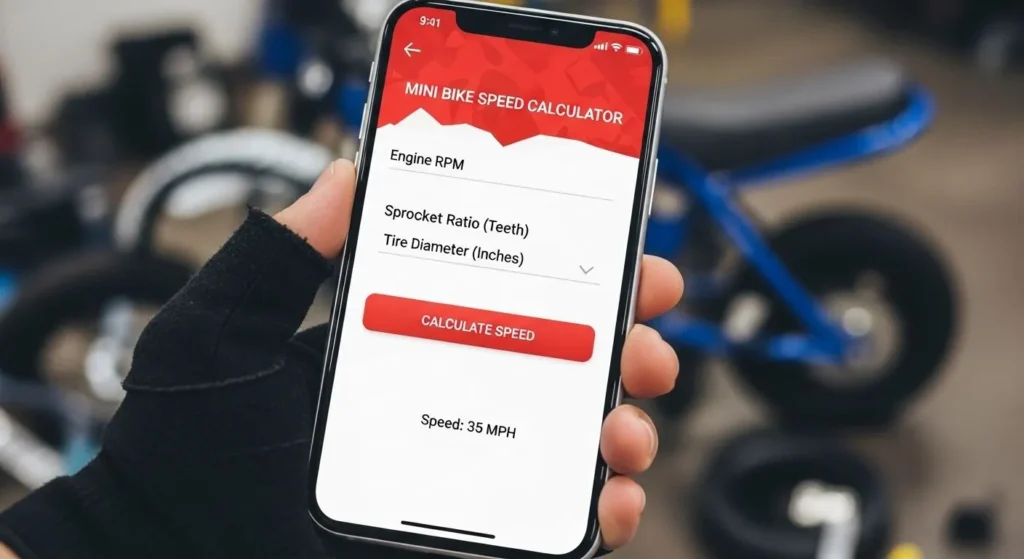
Below is the calculator I put together specifically for mini bike riders. It handles both standard clutch setups and torque converter setups because the drivetrain type changes how you calculate maximum speed. Fill in your specs and the tool instantly gives you your estimated top speed in MPH.
Mini Bike Speed Calculator
What Is a Mini Bike Speed Calculator and How Does It Work
A mini bike speed calculator is a tool that uses the fundamental physics of your drivetrain to estimate the maximum theoretical speed your bike can reach. It is not a speedometer and it does not account for terrain, wind resistance, or rider weight in its basic form, but it gives you the most accurate starting estimate you can get without actually riding the bike.
The math behind it is straightforward. Your engine produces a maximum RPM at full throttle. That RPM passes through your sprocket system which either multiplies or reduces it depending on the gear ratio. The result is how fast your rear wheel spins per minute. Multiply that by the circumference of your tire and you get distance traveled per minute, which converts directly into miles per hour.
Essential Inputs for Accurate Calculations
Getting accurate results from a mini bike top speed calculator depends entirely on entering the right numbers. Here is what each input means and where to find it.
| Input | What It Means | Where to Find It |
| Engine RPM | Maximum rated RPM your engine produces at full throttle | Engine spec sheet or manufacturer website |
| Clutch Sprocket Teeth | Number of teeth on the small sprocket attached to the clutch or engine output shaft | Count the teeth physically or check part specs |
| Rear Axle Sprocket Teeth | Number of teeth on the large sprocket on your rear axle | Count the teeth or check your axle sprocket specs |
| Tire Diameter (inches) | Full diameter of your rear tire from ground to top | Measure with a tape measure or check tire sidewall |
| Drivetrain Type | Whether you use a standard clutch (1:1) or a torque converter (overdrive ratio) | Look at your drivetrain setup physically |
Interpreting Your Results
Once you run the calculation you will get two numbers: your gear ratio and your estimated top speed in MPH. Here is how to read them.
The gear ratio tells you how many times your engine shaft rotates for every one rotation of your rear axle. A ratio of 6:1 means your engine turns six times for every one wheel rotation. Higher ratios mean more torque and better acceleration but lower top speed. Lower ratios mean higher top speed but less pulling power from a stop.
Your top speed in MPH is the theoretical maximum assuming flat ground, optimal conditions, and full throttle. In real-world riding subtract roughly 10 to 15 percent to account for air resistance, terrain friction, and rider weight drag. So if the calculator shows 30 mph, expect real-world performance of around 25 to 27 mph on flat ground.
The calculator gives you a theoretical ceiling. Real-world speed is usually 10 to 15 percent lower due to friction, wind resistance, and rider weight. Use the calculator to compare setups rather than to predict exact speed.
Also Check: Mini Bike Gear Ratio Calculator
Decoding Mini Bike Speed: The Mechanics Behind the Numbers
Understanding what actually controls your mini bike speed makes you a smarter builder and a better troubleshooter. The calculator is only as useful as your understanding of what each input actually does. Here is the complete picture.
The Engine: Powering Your Mini Bike Adventure
Everything starts at the engine. For gas mini bikes the most common setups are the 196cc (6.5hp) and 212cc engines, which typically produce a maximum rated RPM between 3,600 and 4,000 under load. High-performance small engines like the Predator Ghost or modified racing variants can spin up to 8,000 to 9,000 RPM with the right carburetor and cam setup.
Engine size directly affects torque output more than top speed. A bigger engine does not automatically mean a faster top speed unless it also produces higher RPM. What a larger engine does give you is stronger acceleration across the entire RPM range and more ability to maintain speed on inclines and rough terrain.
For the mini bike speed calculator, always use the maximum sustainable RPM rather than the peak RPM. Peak RPM is what the engine hits at the very top of its power band and it is not sustainable for more than a few seconds. Sustainable maximum RPM is the number the engine can hold consistently and that is the realistic input for top speed calculation.
The Critical Role of Gearing: Mastering Speed vs Acceleration
Gearing is where most mini bike performance tuning actually happens. The relationship between your clutch sprocket teeth count and your rear axle sprocket teeth count is what determines your gear ratio and that ratio is the single biggest controllable factor in your top speed equation.
The formula is simple. Divide the rear sprocket teeth by the clutch sprocket teeth. A 72-tooth rear sprocket with a 12-tooth clutch sprocket gives you a 6:1 gear ratio. To increase top speed you either reduce the rear sprocket teeth count or increase the clutch sprocket teeth count. To improve acceleration and low-end torque you do the opposite.
| Clutch Sprocket | Rear Axle Sprocket | Gear Ratio | Approx Top Speed at 3600 RPM (13in tire) |
| 10 teeth | 80 teeth | 8:1 | Approx 18 mph |
| 12 teeth | 72 teeth | 6:1 | Approx 24 mph |
| 12 teeth | 60 teeth | 5:1 | Approx 29 mph |
| 14 teeth | 60 teeth | 4.3:1 | Approx 34 mph |
| 14 teeth | 48 teeth | 3.4:1 | Approx 43 mph |
Use the mini bike speed calculator above to run your own specific numbers. The table above uses 3600 RPM and 13-inch tire diameter as a baseline.
Drivetrain Dynamics: Clutches and Torque Converters
The two most common drivetrain setups on mini bikes are the standard centrifugal clutch and the torque converter and they behave very differently in the speed calculation.
A standard centrifugal clutch operates at a fixed 1:1 ratio once engaged. Your gear ratio is entirely determined by your sprocket setup. This is the simplest setup and the most common on basic mini bikes.
A torque converter like a TAV2 uses a variable belt drive system that automatically adjusts the ratio based on engine load and throttle position. At full throttle and high RPM, a typical torque converter runs a slight overdrive ratio of around 0.9:1 to 1:1 depending on the setup. This means slightly higher potential top speed compared to a clutch bike with identical sprocket ratios. When using the mini bike top speed calculator make sure to select the correct drivetrain type to get accurate output.
Tires and Traction: The Contact Point With the World
Tire diameter is the third pillar of the speed calculation after RPM and gear ratio. A larger diameter tire covers more ground per revolution which increases top speed. A smaller tire covers less ground but responds quicker and handles better at lower speeds.
Most stock mini bikes run tires between 13 and 16 inches in diameter. Performance setups sometimes go up to 18 inches, especially on trail bikes where ground clearance also matters. Even a 2-inch difference in tire diameter can change your calculated top speed by 2 to 4 mph depending on your RPM and gear setup.
Beyond size, tire pressure affects real-world speed more than most riders realize. An underinflated tire creates more rolling resistance which reduces actual speed even when the calculator predicts otherwise. Always check tire pressure before running real-world speed tests to ensure your results match the calculator output.
Weight Matters: Rider and Vehicle Load
The mini bike speed calculator gives you a theoretical top speed based on pure mechanics. What it cannot calculate is the drag created by mass. Every pound you add to the system requires more engine power to accelerate and sustain speed. A 150-pound adult rider on a mini bike will always reach a lower real-world top speed than the calculated maximum compared to the same bike with a 100-pound rider.
This is why real-world speeds are typically 10 to 15 percent lower than calculator outputs. For the most accurate comparison between setups, always test with the same rider weight and same terrain conditions. The calculator is most useful as a relative tool. If setup A calculates 25 mph and setup B calculates 30 mph, you can reliably expect setup B to be meaningfully faster in real life even if neither hits the exact calculated number.
External Factors: Air Resistance, Elevation, and Weather Conditions
At the speeds mini bikes operate, air resistance (drag) starts to become a genuine factor above 25 mph. The faster you go the more energy your engine spends pushing through air rather than accelerating the bike. This is why the gap between calculated and real-world speed widens as top speed increases.
Elevation affects engine performance because thinner air at altitude means less oxygen for combustion. If you ride in high-altitude areas like mountain trails, expect noticeably less top speed and acceleration compared to sea-level riding with the same setup. Carbureted engines are more sensitive to altitude than fuel-injected systems.
Headwinds can reduce effective top speed by several mph on straight runs. Tailwinds can push speeds slightly above the calculated maximum. For the most reliable real-world testing, always run in calm wind conditions on flat ground to get results that actually match your calculator output.
Optimizing Your Mini Bike for Maximum Performance
Once you understand the mechanics and you have run your numbers through the mini bike speed calculator, you can start making targeted upgrades. Here are the most effective ways to increase top speed on a mini bike.
Engine Enhancements: Unleashing More Power
The engine is the starting point for any serious performance build. For gas mini bikes running 196cc or 212cc engines, there are well-established upgrade paths that meaningfully increase both RPM ceiling and torque output.
- Performance carburetor: A larger jet carburetor allows more air and fuel into the combustion chamber which increases power output and raises sustainable RPM. On a stock Predator 212 this upgrade alone can add 500 to 800 RPM at full throttle.
- Upgraded camshaft: A performance cam changes the valve timing to keep the intake valve open longer which improves airflow at high RPM. This is one of the most effective single upgrades for increasing top-end power.
- Header and exhaust pipe: Reducing exhaust backpressure helps the engine breathe more efficiently. A performance header combined with a straight pipe can add meaningful RPM and power.
- Air filter upgrade: Replacing the stock air filter with a high-flow unit increases intake volume. This is a cheap first upgrade that pairs well with a carburetor jet increase.
- Governor removal: Most stock small engines have a governor that limits maximum RPM to protect the engine. Removing or adjusting the governor allows the engine to rev higher. This should only be done alongside other internal upgrades to avoid engine damage from over-revving a stock setup.
Strategic Gearing Choices: Fine-Tuning for Your Ride Style
Gearing is the fastest and cheapest way to change your mini bike’s speed characteristics. Unlike engine modifications, swapping a rear sprocket takes less than an hour and costs very little. Use the mini bike speed calculator to model different sprocket combinations before buying parts.
For pure top speed, reduce your rear axle sprocket tooth count. Going from a 72-tooth to a 60-tooth rear sprocket on a typical setup adds 6 to 8 mph of top speed. The trade-off is slower acceleration from a standstill and less torque on hills.
For a balance between acceleration and top speed on trails, I personally run a slightly taller gear than stock but not extreme. On my own 212cc build I run a 12-tooth clutch sprocket with a 60-tooth rear which gives me around 29 mph calculated top speed. That setup gives me enough low-end pull for trail riding while still being satisfying on flat ground.
Drivetrain Upgrades: Enhancing Power Transfer
Upgrading from a standard centrifugal clutch to a quality torque converter like a TAV2 or Comet 30 series is one of the best performance upgrades you can make for trail riding and mixed terrain. A torque converter automatically varies the drive ratio based on load which means better acceleration from a stop and more efficient power delivery across the entire speed range.
For pure speed on flat ground, a well-adjusted clutch setup with the right engagement RPM can outperform a torque converter. The clutch engages at a fixed RPM and delivers power directly without the belt slip that torque converters experience at peak output. If drag racing or flat track is your goal, a quality clutch with a tight engagement spring tuned to your engine’s power band is the better choice.
Boosting Electric Mini Bike Speed
Electric mini bikes follow different physics but the calculator principles still apply. Instead of engine RPM you are working with motor RPM, and instead of a fuel engine you are managing battery voltage and controller amperage limits.
For electric mini bikes the most effective speed upgrades are increasing battery voltage (more voltage directly increases motor RPM at the controller limit), upgrading the speed controller to allow higher amperage, and adjusting the sprocket ratio the same way you would on a gas bike.
One advantage electric mini bikes have is that their power delivery is instant and linear. There is no RPM build-up like a gas engine so they can often reach calculated top speed more easily than gas equivalents under the right conditions.
Reducing Weight and Improving Aerodynamics
Once you have maximized your engine and gearing, weight reduction is the next lever. Every 10 pounds you remove from the system requires less power to maintain speed and allows the engine to reach its mechanical limits more easily.
Practical weight reduction options include lighter wheels and tires, aluminum sprockets instead of steel, lightweight seat options, and removing non-essential accessories. The aerodynamic profile of a mini bike is already quite low so aggressive aero modifications are not worth the effort unless you are building a dedicated speed record machine.
Beyond the Calculator: Measuring Your Mini Bike Real-World Speed
The mini bike top speed calculator gives you the theoretical number. To find out what your bike actually does in the real world, you need to test it. Here are the methods I have used personally and what each one is best for.
The Stopwatch Method: Practical Speed Measurement
This is the simplest and most accessible method for any rider. Find a large flat open area, an empty parking lot works perfectly. Mark two points a known distance apart. I use 100 feet as my standard because the math is easy and most parking lots have enough space.
Start timing when you cross the first mark at full throttle. Stop timing when you cross the second mark. Then use this formula: feet traveled divided by 5280 equals miles traveled. Seconds elapsed divided by 3600 equals hours elapsed. Miles divided by hours equals MPH.
For accuracy, run at least three passes and average the results. The first pass is usually slightly slower as the bike builds up to full speed. By the third pass you are getting consistent numbers that reflect actual top speed.
Leveraging Technology: GPS Devices and Apps
A GPS speed app on your phone or a dedicated GPS device gives you the most accurate real-world speed measurement available without expensive equipment. Apps like GPS Speedometer and Speed Tracker on iOS and Android are accurate to within 1 to 2 mph at mini bike speeds.
Mount your phone securely on the handlebars or use a riding buddy to record the GPS display during a full-speed run. GPS speed is calculated from actual ground position changes rather than wheel rotation so it is not affected by tire slip or wheel sensor errors.
Onboard Tools: Tachometers and Speedometers
A tachometer that measures engine RPM is an excellent tool for validating your calculator inputs. If you entered 3600 RPM into the calculator but your engine is actually spinning at 3200 RPM under load, your calculated speed will be higher than reality. Installing a cheap digital tach and reading it at full throttle gives you the real RPM number to use in the calculator.
Mechanical or digital speedometers that use wheel rotation sensors are accurate once calibrated to your tire size. They are more convenient for regular riding than GPS apps since they display speed continuously rather than requiring you to look at a mounted phone.
Accounting for Real-World Variables in Testing
Terrain, weather, and rider input all affect results. Always run your speed tests on flat, smooth, dry pavement or packed dirt for the most consistent numbers. Wet surfaces reduce traction which limits how efficiently power reaches the ground. Grass or loose gravel dramatically reduces effective top speed regardless of what the calculator shows.
Rider position also matters more than people expect. Leaning forward and tucking slightly reduces wind resistance and can add 1 to 2 mph on flat runs compared to sitting upright. For pure speed tests, consistent rider position is as important as consistent terrain.
Safety First: Riding Responsibly at Any Speed
I want to be straightforward here. Higher speed is more fun for experienced riders but it dramatically increases injury risk, especially for younger or newer riders. The physics are simple: stopping distance increases with the square of speed. At 20 mph you can stop in a fraction of the distance it takes at 35 mph. That difference matters enormously when something unexpected happens.
Essential Safety Gear: Protecting the Adventure Seeker
- Full-face helmet rated for the speed you are riding. At any speed above 20 mph a full-face helmet is the minimum protection I would recommend for any rider.
- Gloves protect your hands in any fall and also give you better grip control, especially in warm weather when hands sweat.
- Knee and elbow pads are non-negotiable for off-road riding where falls on rocky or hard-packed terrain are common.
- Closed-toe sturdy footwear, ideally boots. Flip flops and sandals around moving drivetrain components are genuinely dangerous.
- Eye protection matters especially off-road where rocks, dust, and debris are part of every ride.
Understanding Your Limits and Your Mini Bike Capabilities
One of the mistakes I see newer riders make is building for maximum speed before they have built the skills to control it. A stock mini bike at 22 mph is actually plenty fast for a beginner to learn on. The skills you build at moderate speeds, smooth throttle control, body positioning, braking technique, line selection on trails, are the same skills that keep you safe when you eventually ride faster.
Before increasing your top speed through gearing or engine modifications, make sure you are completely comfortable at your current setup’s maximum speed. If you are not consistently smooth and in control at 22 mph, adding 10 more is a risk rather than an upgrade.
Choosing Safe Riding Environments
Gas mini bikes are designed for off-road use in the United States. They are not street legal on public roads in most states. Safe riding environments include private land with the landowner’s permission, designated off-road parks and trails that allow mini bikes, large private parking lots with permission, and closed course events.
Avoid public sidewalks, bike paths, and roadways both for safety and legal reasons. Even in states where local ordinances are unclear, riding an unregistered mini bike on public roads creates liability and safety risks that are not worth the convenience.
Regular Maintenance: Keeping Your Mini Bike in Top Condition
- Check chain tension before every ride. A loose chain can skip teeth or jump the sprocket at high speed, which is both dangerous and destructive to the drivetrain.
- Inspect tire pressure every few sessions. Under-inflated tires reduce handling, increase stopping distance, and affect your actual speed compared to calculator predictions.
- Change engine oil on schedule. Small engines on mini bikes run hot and the oil degrades faster than in automotive engines. Fresh oil protects the engine at high RPM.
- Check the throttle cable and throttle return spring. A sticky throttle that does not return to idle quickly is a serious safety issue.
- Inspect brake function before every speed run. Brakes that work fine at 20 mph may not provide adequate stopping power if you have upgraded your setup to 35 mph.
Conclusion: Calculate, Optimize, and Ride Smart
The mini bike speed calculator on this page takes the guesswork out of mini bike performance planning. Whether you are running a stock 196cc with factory sprockets or building a tuned 212cc setup with custom gearing, knowing your theoretical top speed before you ride is genuinely useful information.
The key takeaways from this guide are straightforward. Your top speed is determined by three things above everything else: your engine RPM, your gear ratio, and your tire diameter. Changing any one of those three changes your calculated output. The calculator shows you exactly how much.
For most recreational riders the sweet spot is a gear ratio between 5:1 and 6.5:1 with a reliable engine that stays within its design limits. For performance builders, the combination of a modified engine, lower gear ratio, and real-world testing with GPS verification is the path to knowing exactly what your build can do.
How accurate can a mini bike speed calculator be?
A mini bike speed calculator is highly accurate for theoretical top speed when you enter correct inputs. The calculation itself is based on proven physics formulas. The gap between calculated and real-world speed is usually 10 to 15 percent and comes from real-world factors the calculator does not measure, specifically air resistance, tire deformation under load, drivetrain friction losses, and rider weight. Use the calculated speed as a reliable ceiling and expect actual performance to be slightly below it under normal riding conditions.
What is the single biggest factor influencing mini bike top speed?
Gear ratio is the single biggest controllable factor. For a given engine, changing your sprocket combination can swing top speed by 10 to 20 mph without touching the engine at all. Engine RPM is technically the raw input that starts the calculation, but gearing is where riders have the most direct and affordable control over speed output.
Can electric mini bikes compete with gas models in terms of speed?
Yes, in many cases electric mini bikes match or exceed equivalent gas mini bikes in top speed, especially in the 20 to 35 mph range that most mini bikes operate in. Electric motors produce peak torque instantly which means better acceleration from a stop compared to a gas engine that needs to rev up. The limitation for electric mini bikes is battery range and the ability to sustain top speed for extended periods rather than the peak speed number itself.
How does rider weight affect top speed on a mini bike?
Rider weight directly reduces real-world top speed below the calculated maximum. A heavier rider requires more engine power to overcome gravity and aerodynamic drag. The practical difference between a 120-pound rider and a 200-pound rider on the same mini bike is typically 3 to 6 mph at the top end, depending on the engine size. Lighter riders also notice faster acceleration and better hill-climbing performance with the same gear setup.
Is it dangerous to try to maximize my mini bike speed?
It depends on the context. Chasing maximum speed on a closed private track with full safety gear and an experienced rider is a reasonable thing to do. Chasing maximum speed on public roads, in areas with pedestrians, or without proper safety gear is genuinely dangerous. The same speed that is manageable on a flat straight track becomes very hard to control on rough terrain or when unexpected obstacles appear. Always match your speed to your skill level, your gear, and your environment.
What is the recommended gear ratio for a single speed mini bike?
For general trail and recreational riding a gear ratio between 5:1 and 6.5:1 works well for most 196cc and 212cc engine setups. This range balances top speed with enough low-end torque for hills and soft terrain. For flat-track or speed-focused builds you can go lower, around 4:1 to 4.5:1. For very hilly terrain or heavy riders, going higher to 7:1 or 8:1 gives better control and less strain on the engine.
Does wheel size affect the speed of a mini bike?
Yes, directly. Tire diameter is one of the three main inputs in the speed calculator alongside RPM and gear ratio. A larger tire covers more ground per revolution which increases top speed without changing your engine or sprockets. Going from a 13-inch to a 15-inch tire on the same setup adds roughly 2 to 3 mph at the top end. Keep in mind that larger tires also affect ground clearance and handling, especially on trail bikes.
What is the top speed of a stock Predator Ghost mini bike engine?
The Predator Ghost 212cc engine in stock form is capable of sustainable RPM up to approximately 4,200 to 4,500 RPM compared to the standard Predator 212 which runs around 3,600 RPM under load. On a typical mini bike setup with a 6:1 gear ratio and 13-inch tires, a stock Ghost setup produces a calculated top speed of approximately 28 to 32 mph. With performance modifications including a cam, carburetor, and exhaust upgrade, experienced builders have reported over 40 mph on flat ground.
Do mini exercise bikes under the desk work for burning calories?
Mini pedal exercisers and under-desk bikes do burn calories but not at a rate that would substitute for dedicated cardio exercise. Light pedaling while working burns roughly 100 to 150 calories per hour depending on resistance and effort. Over a full workday that adds up meaningfully for sedentary workers. They are primarily useful for improving circulation and leg movement during long desk sessions rather than for high-intensity calorie burning. This is a completely different product from the off-road mini bikes covered in this calculator guide.