If you want electric assistance on your rides, there are two ways to get it. You can buy a complete e-bike from a shop, or you can fit a conversion kit to a bike you already own. Both work, and both can give you years of reliable riding. But they suit different riders, different budgets and different bikes.
This guide compares the two options honestly: cost, performance, reliability, maintenance, weight and the kind of rider each one suits best. By the end, you should know which route makes sense for you, and what to check before you spend any money.
What Is an E-Bike Conversion Kit?
A conversion kit turns a standard bicycle into an electric one. A typical kit includes a motor, a controller, a display, a pedal assist sensor, a throttle or control pad, brake levers with motor cut-off switches and all the wiring. The battery is sometimes included and sometimes sold separately, depending on the kit.
There are two main types of kit:
- Hub motor kits, where the motor is built into a new front or rear wheel that replaces your existing one.
- Mid-drive kits, where the motor mounts at the bottom bracket and drives the cranks, so it works through your bike’s gears.
Once fitted, a converted bike rides much like a factory e-bike. You pedal, the sensor detects it and the motor adds power according to the assist level you choose on the display.
The Case for Buying a New E-Bike
A complete e-bike has real advantages, and for some riders it is clearly the better choice.
Everything Is Designed to Work Together
On a factory e-bike, the frame, motor, battery, brakes and wheels are chosen as one system. The battery is often integrated into the down tube, the cables are routed inside the frame and the whole bike looks clean and finished. Brakes and wheels are specified for the extra weight and speed from the start.
One Warranty and One Point of Contact
When something goes wrong on a new e-bike, you take it back to the shop or the brand. There is no question of which part is at fault, because the whole bike is covered as one product. For riders who do not want to deal with any technical detail, that simplicity is worth a lot.
No Installation Needed
You collect the bike and ride it home. There is no fitting, no adjustment and no learning curve beyond getting used to the assistance.
The Case for Converting Your Own Bike
For many riders, especially those who already own a decent bike, converting is the smarter option.
Lower Cost for the Same Performance
A complete e-bike includes the price of a new frame, new components and a brand name. A conversion kit only adds the electric parts. If your bike is already in good condition, a quality kit and battery typically cost noticeably less than a new e-bike with similar power and range. The savings are biggest when you compare kits with mid-range and premium e-bikes, where prices rise quickly.
You Keep the Bike You Already Love
Your current bike already fits you. The saddle, the bars, the riding position and the handling are all familiar. A conversion keeps all of that and simply adds power. This matters more than many people expect, especially for riders with a favourite frame, a custom build or a specific fit for back or knee comfort.
More Power and Flexibility
Conversion kits are available in a wider range of power levels than most off-the-shelf e-bikes. You can choose a gentle kit for commuting, a stronger one for steep hills or carrying loads, or a high-power kit for off-road use on private land. You also choose your own battery size, so you can build exactly the range you need rather than accepting whatever a manufacturer decided.
Easier to Repair and Upgrade
Many factory e-bikes use proprietary motors, batteries and software. When a part fails out of warranty, you may only be able to buy it from one brand, if it is still available at all. Conversion kits generally use standard connectors and widely available parts. A worn controller, a damaged display or a tired battery can usually be replaced on its own, and you can upgrade the battery or the motor later without replacing the whole bike.
A More Sustainable Choice
Converting an existing bike keeps a perfectly good frame and components in use instead of buying a new one. If you have an older bike sitting in the shed, a conversion can bring it back into daily use.
Side-by-Side Comparison
Here is how the two options compare on the points most riders care about.
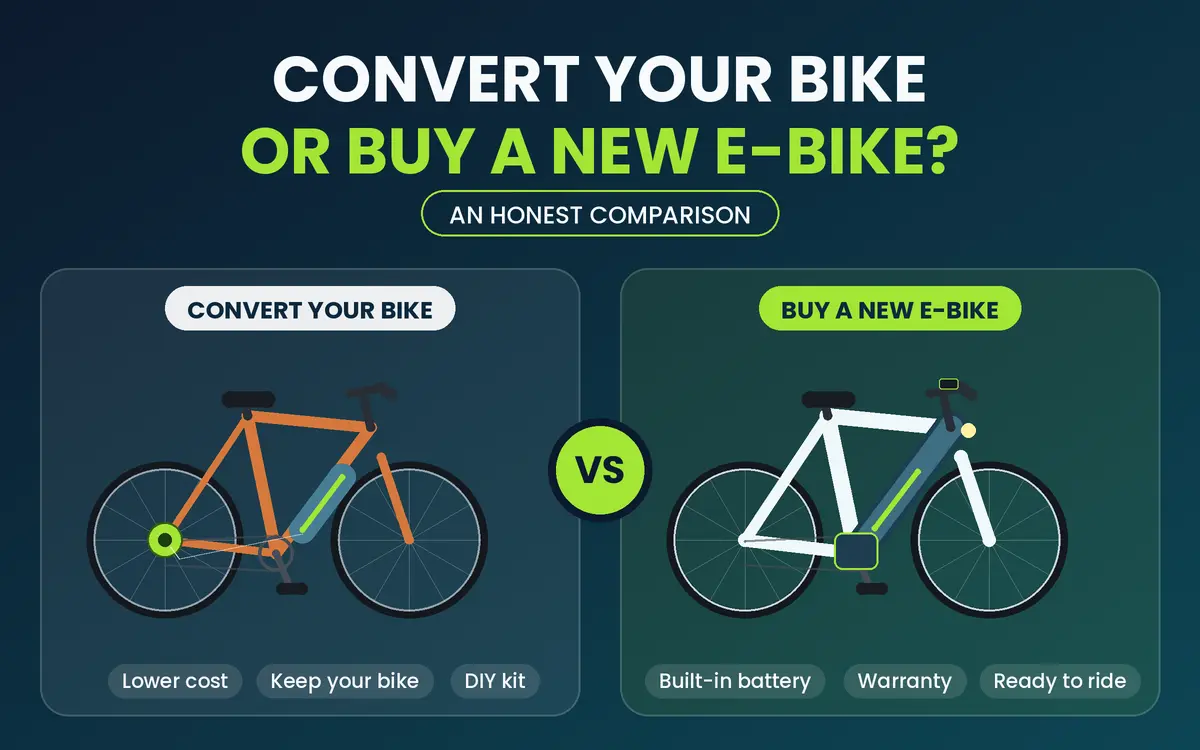
- Upfront cost: a conversion is usually cheaper if you already own a suitable bike; a new e-bike costs more but includes a new bike.
- Choice of power: conversion kits offer a wider range; new e-bikes are usually limited to modest power levels.
- Choice of range: with a conversion you pick your own battery size; with a new e-bike you are limited to the battery options the brand offers.
- Looks: new e-bikes with integrated batteries look cleaner; a well-fitted conversion looks neat, but the battery is usually visible.
- Installation: a conversion needs fitting, either by you or by a mechanic; a new e-bike is ready to ride.
- Repairs: conversion parts are generally standard and replaceable individually; new e-bikes often rely on brand-specific parts.
- Warranty: a new e-bike has one warranty for the whole bike; a conversion kit’s warranty covers the electric parts, while the bike itself is your responsibility.
Hub Motor or Mid-Drive: Which Kit Suits a Conversion?
If you decide to convert, the next big choice is the type of motor. Both work well, but they feel different on the road.
Hub Motor Kits
Hub motor kits are the simplest to fit. You swap a wheel, mount the battery and controller, fit the display and sensor, and connect the cables. They are quiet, need very little maintenance and put no extra strain on your chain or gears. Rear hub motors give the most natural feel and the best traction, while front hub motors are even easier to fit and leave your rear gears untouched.
The trade-off is that a hub motor runs at the speed of the wheel. On long, steep climbs it works hard at low speed, and it cannot use your gears to help.
Mid-Drive Kits
A mid-drive motor sits at the cranks and drives the bike through its gears. Shift down on a hill and the motor gets the same mechanical advantage your legs do. That makes mid-drives excellent climbers and very efficient on hilly routes, mountain trails and with heavy loads. Weight is also kept low and central, so the bike handles well. Popular choices such as Bafang mid-drive kits are widely used for exactly this reason.
The trade-off is extra wear on the chain and cassette, because the motor’s power goes through them. Smooth gear changes, easing off the power while shifting and replacing the chain a little more often keep that under control.
A Quick Rule of Thumb
Mostly flat commuting and easy fitting: a hub motor kit. Hills, trails, heavy loads or long rides: a mid-drive kit.
Is Your Bike Suitable for Conversion?
Not every bike makes a good conversion. Before you buy a kit, check these points.
Frame Condition and Material
Steel and aluminium frames in good condition are ideal. Check carefully for cracks, especially around the welds, the bottom bracket and the dropouts. Carbon frames are generally not recommended for conversions, because clamping a motor or mounting a heavy battery can damage them.
Brakes
An e-bike is heavier and usually faster on average than a standard bike, so good brakes are essential. Disc brakes, especially hydraulic ones, are the best match for a conversion. Good quality rim brakes can work for lower-power kits, but upgrading the brakes is one of the most worthwhile parts of any build.
Wheel and Dropout Sizes
For a hub motor kit, you need to know your wheel size and the width of the dropouts where the wheel fits. The kit’s wheel must match both. On higher-power hub kits, a torque arm is recommended so the motor’s axle cannot turn in the dropouts.
Bottom Bracket for Mid-Drives
For a mid-drive kit, the bike needs a standard threaded bottom bracket of a width that the kit supports. Check the bottom bracket shell width on your bike against the kit’s specification before ordering. Press-fit bottom brackets usually need an adapter or are not compatible.
Space for the Battery
Look at where the battery will go. The most common position is the down tube, using the bottle cage bolts. If your frame has no room there, a rear rack battery or a frame bag battery can work instead.
What About Installation?
Fitting a conversion kit is well within reach of anyone comfortable with basic bike maintenance. A hub motor kit usually takes an afternoon. A mid-drive kit takes a little longer, because the cranks and bottom bracket have to come off and the chainline needs checking.
The jobs that cause most problems are tidy cable routing, setting the brake cut-off switches correctly and making sure every connector is fully pushed home. If you are not confident, a bike mechanic who works with e-bikes can fit the kit for you, and many specialist kit sellers offer fitting as a service.
Maintenance Over the Years
Both options need the same basic care: clean and lubricate the chain, check the brakes regularly, keep the tyres at the right pressure and look after the battery. With a converted bike, it is worth checking that the motor mounting and cable ties are still tight every few months, and that no cable is rubbing against the frame or the wheel.
Battery care is the same either way. Charge at room temperature, avoid charging below freezing, store the battery partly charged during long breaks and use only the correct charger.
Who Should Choose Which?
Buy a New E-Bike If…
- You do not own a bike that is in good condition and fits you.
- You want a clean, integrated look with the battery hidden in the frame.
- You prefer a single warranty and a shop to handle everything.
- You have no interest in fitting or adjusting anything yourself.
Convert Your Bike If…
- You already own a good bike that fits you well.
- You want more power or more range than typical e-bikes offer.
- You want to keep costs down without compromising on performance.
- You like the idea of standard parts that can be repaired and upgraded over time.
Final Thoughts
There is no single right answer. A new e-bike is the easy, all-in-one choice for riders who want a finished product and do not own a suitable bike. A conversion is the better value, more flexible choice for riders who already have a bike they love and want to choose their own power and range. If that sounds like you, browse a range of e-bike conversion kits, check your bike against the points above and you could be riding with electric assistance on the bike you already know.
About the author: George Andrusca is the founder of All4eBikes, a UK e-bike conversion specialist based in Cardiff. He works as a senior mechanic and electrical engineer, building and repairing electric bikes and conversion kits.
Frequently Asked Questions (FAQs)
Does a conversion kit make a bike much heavier?
A typical kit with its battery adds several kilograms to the bike. With a mid-drive kit or a down tube battery, the weight sits low and central, so it is barely noticeable once you are moving.
Can I still ride a converted bike without power?
Yes. Hub motors and mid-drives both let you pedal normally with the system switched off. You will feel the extra weight, and a hub motor adds a small amount of drag, but the bike rides like a normal bicycle.
Can I remove the kit later?
Yes. A conversion is reversible. You can refit the original wheel or cranks and return the bike to standard, or move the kit to another suitable bike.
Will a converted bike be reliable?
A quality kit, fitted carefully on a bike in good condition, is as reliable as a factory e-bike. Most problems come from rushed installation, loose connectors or a battery that does not match the controller.

Sachin Kadwal is the founder of TurinBikes, with 5.5+ years in SEO and digital research. He rides regularly and creates honest, data-backed bike guides based on verified reviews and real-world testing.”